
Edge Solutions
Silo Weight Monitoring — Wireless Strain Nodes + ITM Connect
“The silo structure becomes the scale — inventory by weight, with no cutting, lifting or emptying.”
Silo Weight Monitoring
- Weight, not level: the mass in each silo — the number that drives reorders and reconciliation — without the dust, rat-holing and dielectric-drift failure modes of radar and ultrasonic.
- No cutting, lifting, jacking, welding or emptying — strain gauges bond to the skirt or the legs while the silo stays in service.
- No cables to the silos: battery-powered wireless strain nodes on a Zigbee mesh report to one gateway.
- Results in your systems — weight, percent full, status and alarms for the PLC, SCADA, historian or ERP, not locked in a stand-alone box.
Silo Monitoring App
Everything in a silo rests on its skirt or its legs, so the compressive strain in that steel is proportional to the material inside. Full-bridge strain gauges, each set with its own temperature sensor, are bonded to the structure and read by ITM Wireless Strain Nodes. The Silo Monitoring App is what turns that strain into inventory. Running on ITM Connect at the edge, it combines the nodes on each silo so off-center fill and wind bending cancel, compensates the daily temperature swing on the steel, and scales the result to weight. It shows every silo on one screen, trends deliveries and draw-down, and serves the same numbers to the plant network.
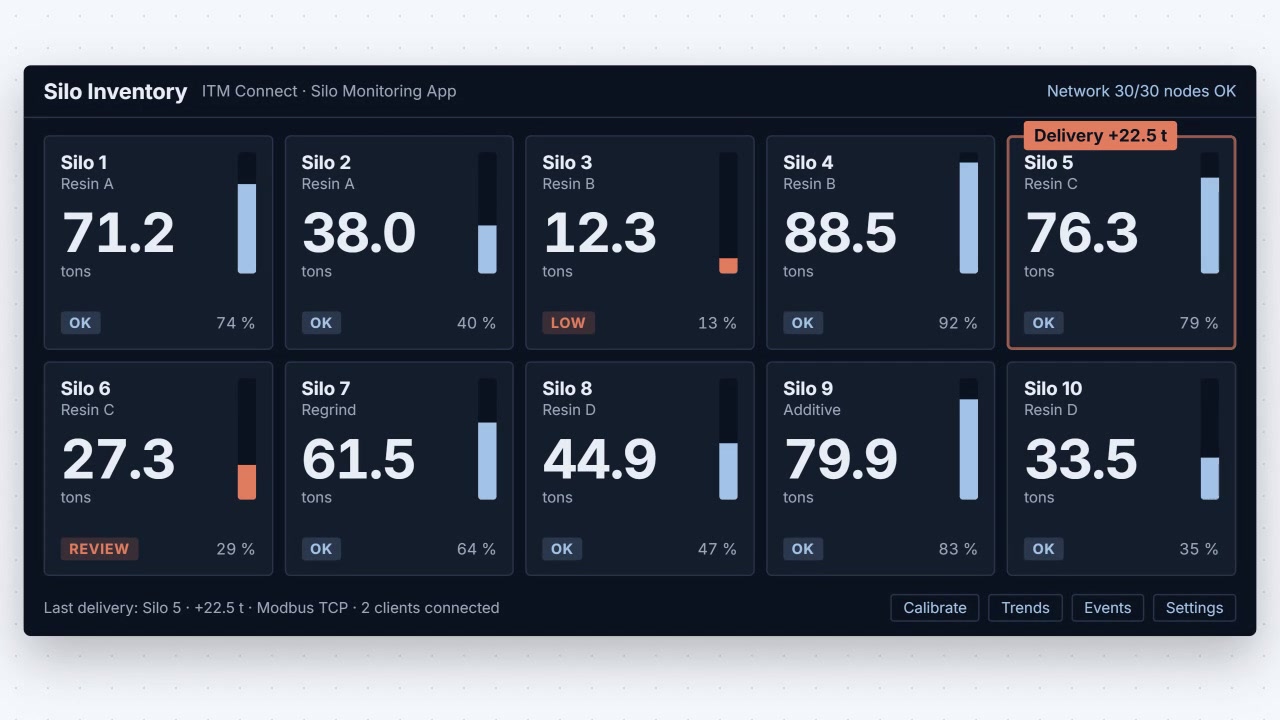
- Every silo on one screen — weight, percent full and status for each silo, on the ITM Compute Panel at the silos and in a browser on the plant network.
- Calibrated with your deliveries — the app zeroes each silo, then sets its span from the weigh ticket of a normal delivery. No test weights, no emptying.
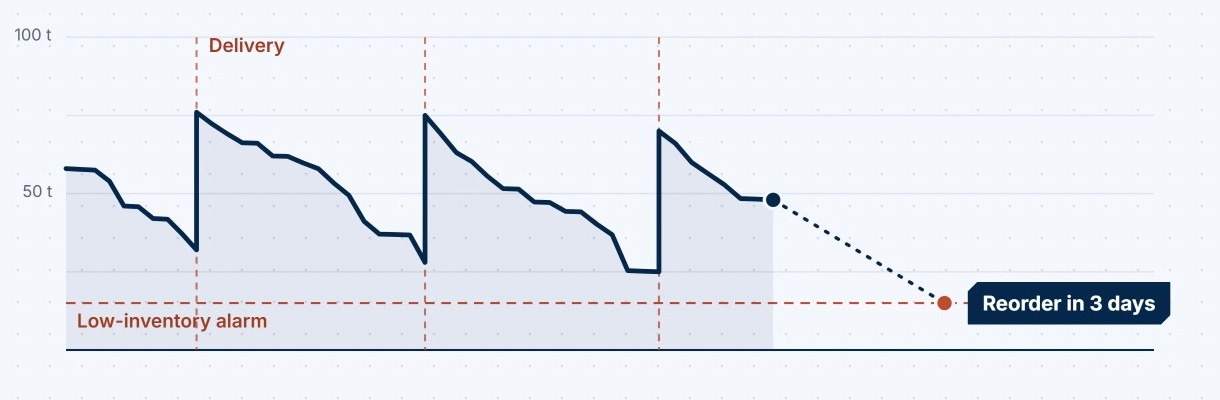
- Trends deliveries and draw-down — delivery events and usage are stored locally and trended against a low-inventory alarm, giving days-to-empty and a reorder date, not just a number.
- Publishes it to the plant — Modbus TCP, EtherNet/IP and Modbus RTU over RS-485, with a cloud-connected option for dashboards across sites.
- Reports node health — the status of the wireless nodes on each silo is served alongside its weight.
- Grows with the site — each silo keeps its own tare, span and material density. Start with one silo, then add the rest.
At a glance: 3 nodes per skirted silo, 1 node per leg · full-bridge strain plus temperature, 24-bit · one reading per minute · 2.4 GHz Zigbee mesh · battery life measured in years · typically within 2–5% of full scale once spanned · a plant inventory tool, not a legal-for-trade scale.
Weight is the differentiator. A level sensor sees the surface, and pellets, powders and dust make the surface unreliable. Strain in the structure responds to the mass itself, whatever shape the material takes inside the silo. Strain on steel is very repeatable — and repeatability is what reorder points and reconciliation depend on. Nothing goes inside the silo, and nothing on it is cut, drilled through or welded.
Skirt or legs. The same scale.
How the silo carries its load decides where the gauges go. The same wireless strain node, the same mesh and the same app weigh a skirted silo or a silo on legs — so the question is not whether the silo can be weighed, but where its load path is cleanest. Read how strain gauges turn a silo into a smart weighing system →
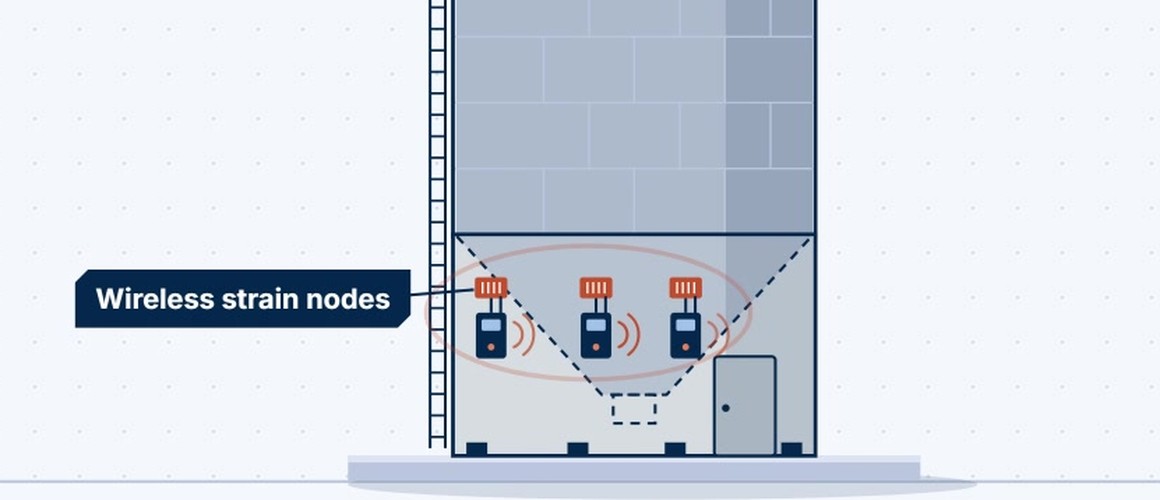
Skirted silos
The skirt is a continuous steel shell that carries the whole bin to the slab — a clean, linear load path. Three full-bridge gauge sets are bonded 120° apart inside the skirt, out of the weather, and averaged so off-center fill and wind cancel out.
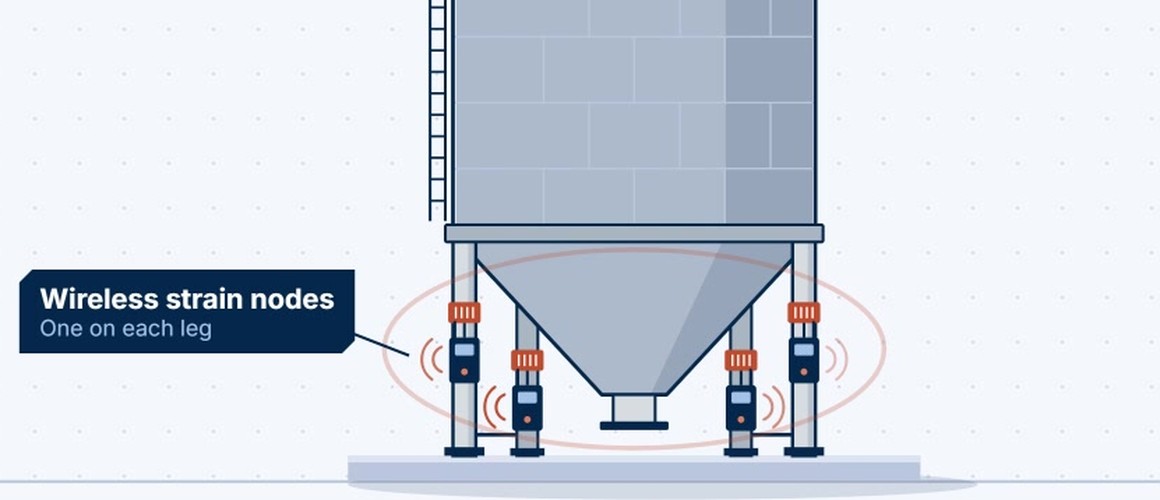
Silos on legs
A hopper-bottom silo on a leg frame carries its load down each leg. One wireless strain node on each leg measures that leg’s share, and the app sums them so off-center fill and wind cancel out.
One network for the group
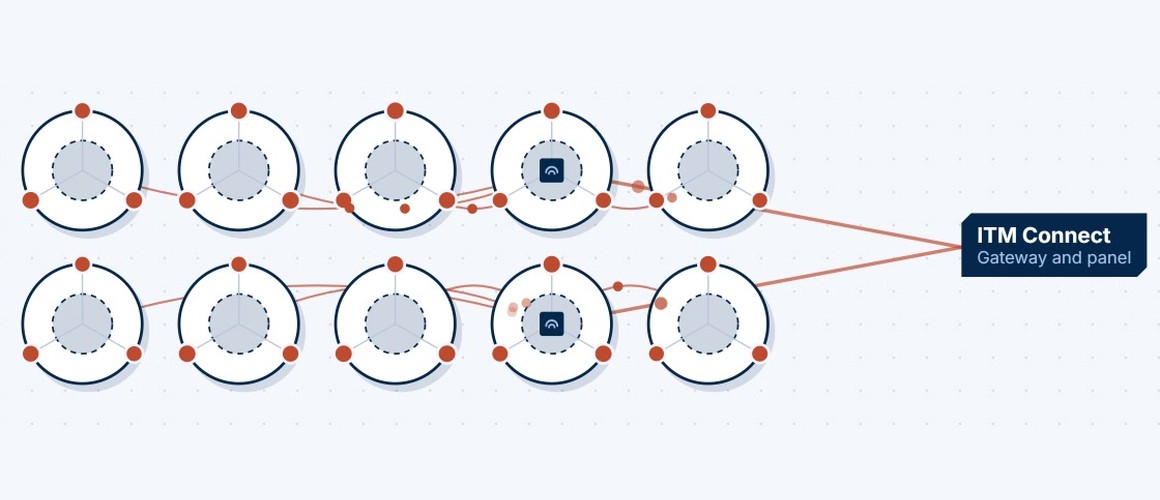
Nodes join a self-healing 2.4 GHz Zigbee mesh. Routers relay the whole silo group to one gateway, which shares an enclosure with the ITM Compute Panel running ITM Connect. No conduit, trenching or cable trays.
On legs: four nodes, zero cables
On a silo with legs, nothing changes but where the gauges go: one wireless strain node per leg instead of three around the skirt. The mesh, the Silo Monitoring App, the calibration from deliveries and the outputs to the plant are the same.
Each node reads the strain in its own leg, and the app sums the four so off-center fill and wind cancel out. The gauges bond to the legs while the silo stays in service — no cutting, lifting, jacking or emptying.
Calibration works the same way as on a skirted silo: the app zeroes the silo, then sets its span from the weigh ticket of a normal delivery.
6-month pilot on a branded customer site validated accuracy through real inventory cycles.
Next step: start with one silo, then add the rest.
Talk to an engineer: (844) 837-8797 · info@iTestSystem.com
Related Edge Solutions resources
-
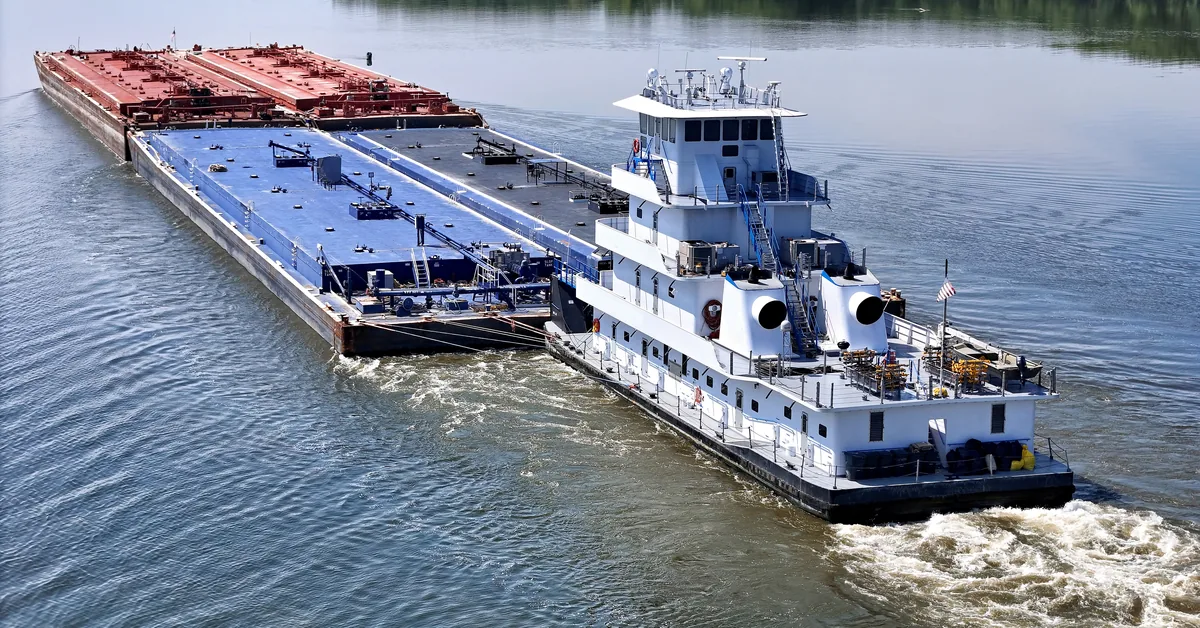
Wireless Torque. Connected Fleet. Meet ITM at the International WorkBoat Show 2026
Visit ITM at the International WorkBoat Show in New Orleans, Dec. 2–4, 2026, and see how ITM Connect turns shaft torque into insight for one vessel or a fleet.
-
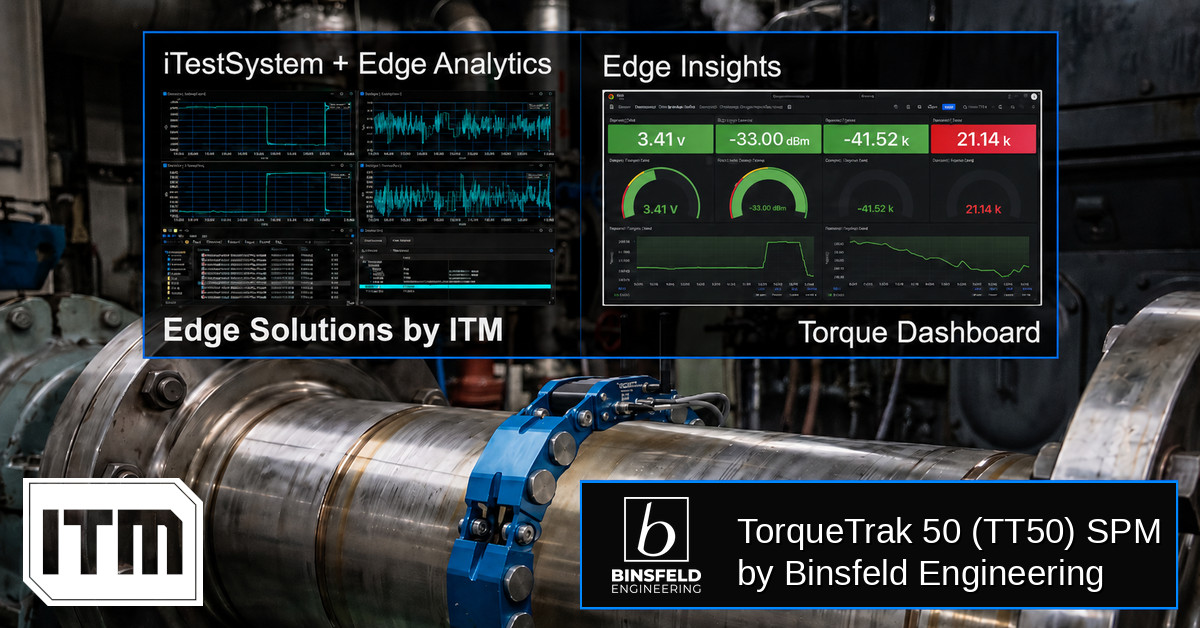
Torque-based Edge Insights: ITM iTestSystem Automated Analytics + Binsfeld TT50
In industrial and marine environments, the drivetrain is often the most critical — and least monitored — part of the system. Rotating shafts transferring torque through gearboxes, couplings, and propellers generate enormous forces that, left unmeasured, become the root cause of unexpected failures, unplanned downtime, and costly maintenance cycles. Traditional torque measurement solutions require shaft…
-
 Ash Hopper Monitoring, Boiler Monitoring, Condition Monitoring, Edge Solutions, Industrial Data Acquisition, industrial IoT, Industrial Monitoring, Power Plant Monitoring, Predictive Maintenance, Recovery Boiler, sootblower monitoring, Strain Gauge Monitoring, Thermocouple Monitoring, vibration monitoring, Wireless Monitoring
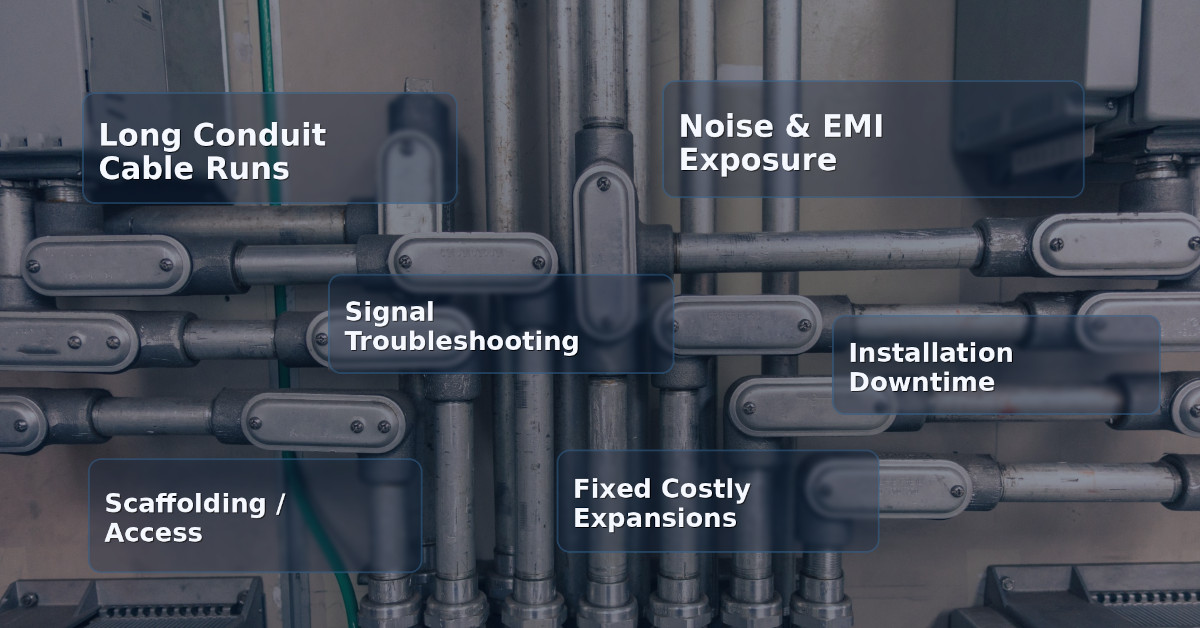
Hardwired vs. Wireless Industrial Monitoring: When Does Wireless Actually Make Sense?
For decades, hardwired data acquisition has been the default standard for industrial monitoring. From strain gauges on structural supports to thermocouples in recovery boilers, running conduit and pulling cable has been considered the “safe”…